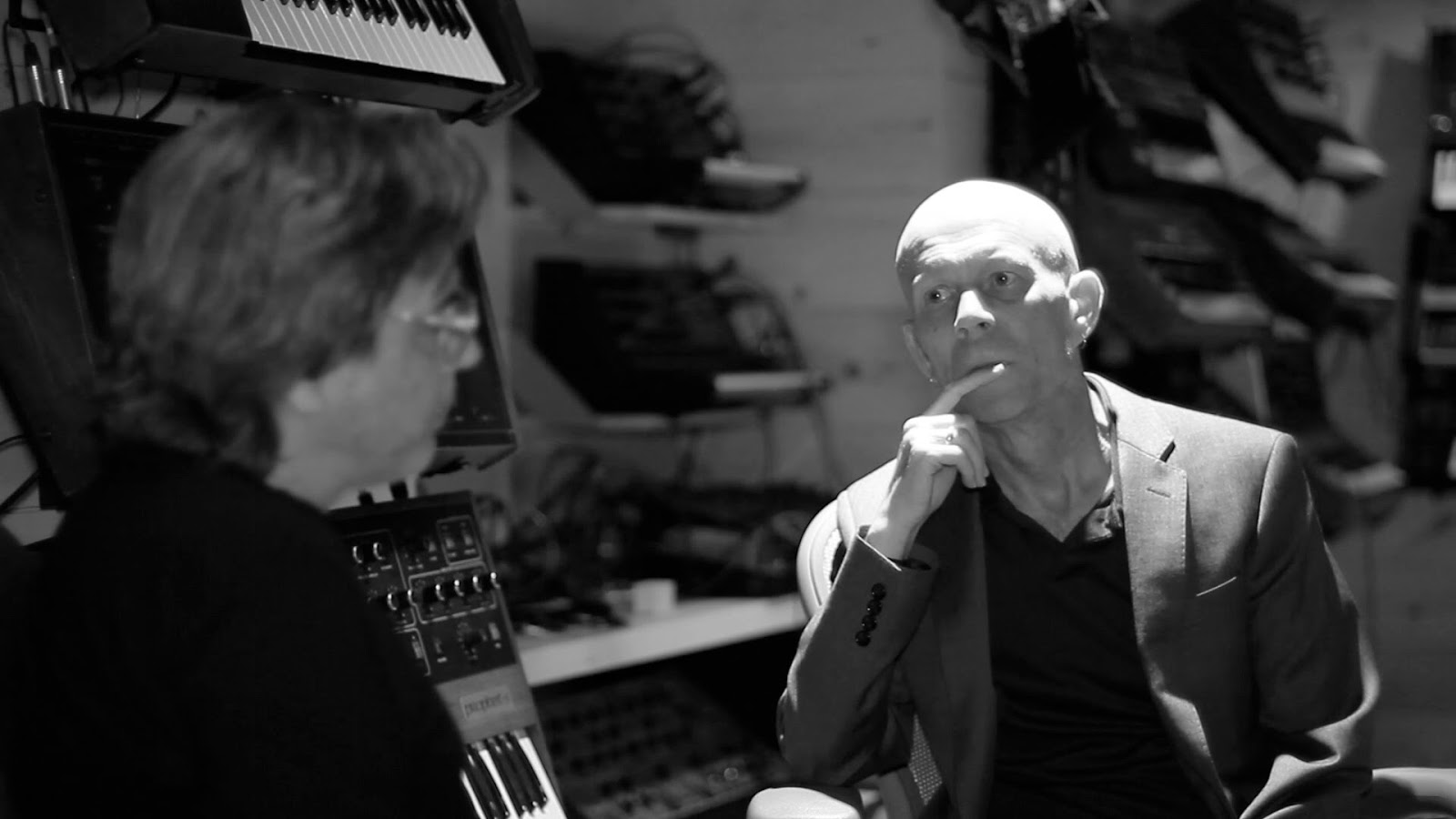
Posts tonen met het label electronica. Alle posts tonen

vrijdag 10 april 2026

Yvelines

A new collaboration with Peter Dekker, and there is a lot to tell about!

Preparations
Upcoming "Yvelines" release is a project which actually started rather basic.
After the "Live at BYSS" performance (2020) and album release (2023) by Däcker (Peter Dekker) and me, we talked about our next step. In fact we immediately came up with the idea to do something with a piano - and preferrably a grand piano - instead of the usual electronics and sythesizers.

Both Peter and myself are musically schooled, so why not challenge ourselves to create something 100% played manually? Putting our emotions and state of mind directly into the music. And if we wanted to hear a sequencer, we had to play it with our hands, instead of pre-programming it. Indeed also entirely improvised, just like was the case with out debuting BYSS collaboration. But playing a piano requires a different approach, by means of sound and dynamics, as well as the touch and way of playing and creating on this classical instrument.

When good friend David Smelik (we are going back for around 25 years) had connection with someone with a grand piano in his living room, we got the opportunity to record here, on this wonderful instrument, for a whole day.
At that point we were still about to 'just' record some sessions on the piano, complemented with a small amount of electronica. This time, largest part of the electronica was not to be used as direct sound generators, but rather as units for the processing and modulating of the piano, and for sound effects. Besides my Korg MS-20 (processing and FX) and Korg ER-1 (processing and rhythmic FX), we also included Peter's Sequential Prophet-5 (pads and FX). In this way we were able to create more contrast with the traditional piano output as well as a more dynamic atmosphere. Which resulted in the sound we were looking for, and which inspired our musical output.

When preparing these recordings, the initial 'simple' project became slightly more ambitious. Then we also brought some percussion tools to play the piano strings, besides playing the piano keys traditionally. During the sessions Peter also used his door keys, and David randomly got a drinking glass from the shelves, to affect the strings.

Remy, David and Peter.
Audio recording
Then, when it came to recording, David (who has quite some knowledge - and owns a lot - of recording equipment, and especially microphones) suggested to go for the best equipment we could get within our budget, so we ended up with 2x Neumann U87 (overhead recording of the piano) and two U67 (for the environment registration) microphones, as well as a Rupert Neve 5024 pre-amp. The recordings were made on two Zoom L20's, on 24 bits 96 kHz, to work with the highest quality option available for us.

That should be it.

Or not...

Video
David also owns a camera to shoot video in 4K, so as bonus he also filmed a lot of our sessions. Until then, no plans at all to do something with the footage. But after the audio selection process (we recorded around 6,5 hours of improvisation), we also noticed the video recordings added a whole dimension to a part of the selected audio.

Video editing.
So we aimed for an additional DVD. Actually immediately considering a blu-ray option, as everything was filmed in 4K. With the edit we had to crop and zoom footage, so effectively maintaining 4K would not be manageable. Therefore we chose to go for 1080P, which equals Full HD, and which is still very detailed. One of the restrictions for DVD video is 720P, which visually makes a huge difference, and in this case we should have had decreased the quality significantly. Regarding the audio, DVD can handle upto a maximum of 24 bit 48 kHz. Which in fact would have been more than sufficient compared to the 24 bit 96 kHz we recorded, mixed and mastered.

4K blu-ray would have been an option, but really specific as you also need a special player to be able to watch the disc. So then the dilemma came to choose for DVD or regular blu-ray. As stated earlier, we should have done too much consessions regarding the video resolution, when choosing for DVD. With blu-ray another issue came up, as there have to be paid rather high licensing fees for having factory pressed discs. For obvious reasons I am not fond of CD-R's, and also any other -R carrier. But as we were considering small quantities, BD-R actually seemed to be the only realistically affordable option.

The way things have been filmed are in line with how the music was established: completely improvised. So just like the music, it's not perfectly polished, but couldn't have given a better organic impression how things were at that certain moment.

And as a result of working with one camera only, we couldn't avoid having some gaps in between the various shots. And there were indeed parts that weren't useable. To fill the gaps for the main video, but even more important: to create an interesting watching experience and fit it to the conceptual story we had in mind, we decided to shoot additional video on location in a later stage. And on some places we were able to use some b-roll, from the other recorded sessions.

Actually immediately we chose for a black and white video experience, which felt the right thing to do.

The sessions

On the day before we were about to record things, David, Peter and I set up all equipment, so we could directly start the next day. August 5th, 2024, we fine-tuned our setup and started to play, while everything was being recorded.

While the first recordings were made, the microphone positionings were still about to be adjusted, as any centimeter actually made a huge difference in the sound registration.

When we found the right positioning of the microphones and fine-tuned all recording settings, things evolved during the sessions. The whole process was progressing with the minute, and when we finished the longest session (which was session 7 of the 8 we did, so in fact rather near the very end of the day), we immediately knew this would become the main track for an eventual album release.

Track selection and mixing
For the final selection, we came to a wonderful storytelling tracklist of three of the final tracks from our day sessions. As we numbered all of the sessions, we felt Session 6, followed by the almost one-hour Session 7, and concluding with Session 5 worked best. Initially considering to swap 5 en 6, or keep everything in chronologically recorded order, would have resulted into a completely different over-all experience.

Additionally, we had to decide what we wanted to do with the video footage. So we started to work towards getting all video recordings together, to see what was useful. We soon concluded that we had to focus on the long seventh session, which in fact was filmed for the largest part (only containing some interruptions to take photos with the same camera), and which actually tells a story on its own. This 58-minute track was established as one big improvisational state of mind, and in fact Peter and I already knew this track should be featured on the release, when the session was done.

In a few weeks after the recording of the sessions I made the mixes. The long track needed some more time, and in January 2025 also this final mix was ready.

Concept
The story actually starts with good friend and fellow musician Dominique Perrier. Together with Roger Rizzitelli, Dominique was initiator of the legendary French band Space Art, which started their successful career in 1977.

Peter, Remy and Dominique.
When I visited Raizeux (in the Yvelines region, just outside Paris, where Dominique lived) in November 2022, there was already been worked on the second Space Art album to be released on my label. Dominique told about some health issues which became slightly worse.
The evening of November 29th Michel Geiss came over to Dominique's place, to talk about the new album and to discuss the mastering of it, which he agreed to do.
I spoke to Michel various times before, mainly linked to the mastering of recent Space Art albums, but on this evening it was finally time to meet each other for the first time.
It was a wonderful - and without getting emotional, I really experienced a magical - evening, where Michel shared so much wonderful memories, and both Dominique and Michel seemed to be frequently touched by their shared history, for a large part connected to their precious times with Jean Michel Jarre.

In January 2023, Peter and I visited Paris with some friends, to attend a concert by Jean Michel Jarre at IRCAM. I also visited Dominique again, this time together with Peter, to introduce each other as fellow musicians from my Deserted Island Music record label.
Then, in the summer of 2023, Peter and I planned to visit Paris to visit Dominique again, as well as some other friends, including Michel.

But then, things went slightly different...

A couple of months earlier, Dominique's health issues got worse.
When Peter and I went to visit him in July, he was in the hospital which he did never leave.
Luckily we got to see Dominique there and hand him over "Personaly Duty", which was the second Space Art album about to be released on my label.

During these days we also appointed with Michel Geiss at the wonderful location of Pavillon Henry IV at Chateau de Saint-Germain-en-Laye. Which became the location to shoot additional video footage, when Peter and I returned here on March 1st and 2nd, 2025.

These encounters became an important part of our "Yvelines" project, being referred to in the main suite of the album.
"Rendez-Vous" as representation of the valuable meetings we had these days.
Besides the directly connected "Saint-Germain-en-Laye", "Chateau de Saint-Germain-en-Laye" and "Pavillon Henry IV", "l'Observateur" and "Anecdotes d'Une Belle Histoire" are linked to Michel and his wonderful stories of the past. While "Réalité en Temps Réel" as well as the opener "La Vie à Raizeux" en final track "Un Dernier Adieu à Rambouillet" are direct references to Dominique.

Dominique passed away on October 4th, 2023.
Peter and I went back to Rambouillet to attend the farewell ceremony on October 12th.
And this also is the part where our "Yvelines" project ends.

"Yvelines" is dedicated to Dominique Perrier.

Mastering
With the concept we had in mind, we asked Michel Geiss to master our project. Which he was willing to do! As we definitely wanted to maintain all dynamics, Michel took note of our instructions, and managed to improve the mixes I made. I really love his master, which is still very close to my final mix.

5.1 Session at Audiochef.
5.1 Surround
When getting involved into the blu-ray process, and having the opportunity to do something with the sound experience, we got in touch with Misja van Waterschoot. Misja and I know each other for quite some years, although we never had intensive contact. Besides his musical activities as Meesha, he is part of the Audiochef team, has his own studio in Hilversum, and has sound engineering experience for over 30 years.

The idea was to create a 5.1 surround mix as option for the blu-ray video. Which had to be done from Michel's 2.0 master, expanding it with the seperate environment recordings, and creating a spatial environment with the electronica multitracks. Simply because we didn't record the audio as 5.1, as this was not our initial intention. In the end, it was our artistic choice to do it this way, which worked out very well in my opinion.

So standard you will be listening to the 2.0 master when watching the blu-ray video (and indeed the CD), having a menu option to listen on 5.1 equipment.

Behind the Scenes
As mentioned before, there has been recorded a lot of audio and video footage. To give insight in the recording process, and to get a taste of the atmosphere, for both the sessions as on location, we also felt the need to compile some of this footage as blu-ray bonus. Consisting of raw unmastered audio, and in colors instead of black of white of the main video, complemented with a valuable selection of photos.

For the largest part there are featured outtakes from other sessions which didn't appear on the final album selection.

Try-out at the Pletterij
Peter and I had our first try-out for the concept of "Yvelines" live on stage during "De Keuken" mini-festival at the Pletterij in Haarlem, September 15th, 2025. It was just a short performance (30 minutes) and although we used the concept and some elements from the album, it became a standalone performance with a rather different content and feel.

Watch the video here:
https://www.youtube.com/live/jIDinKASfSY?si=bLg_DL-p0YYLuI0M
Our part starts around the 19 minutes mark.

Album release
"Yvelines" will be available on CD and as digital download. And be sure to grab the limited edition CD with Blu-ray if you want the complete experience.

Album info and pre-ordering:
https://www.desertedislandmusic.nl/product/remy-dacker-yvelines/

Promo video:
https://youtu.be/ezvJU2rA4dI

Album presentation concert
In first instance we scheduled an album presentation concert at De Vioolkist in Hilversum, on April 10th, 2026.

Very unfortunate this event had to be cancelled due to poor ticket sales.

We had a nice amount of people who bought a ticket to join Peter Dekker and me this Friday, but unfortunately it's not enough to cover the costs of the venue. Funding the financial gap ourselves would have been too costly.

Everyone who bought a ticket, should get refund from the venue shortly. Sorry for the inconvenience, but thanks so much for your valuable support!

The good news is that we have been working hard to get fixed an alternative to properly promote our upcoming "Yvelines" project. Accessible for everyone, starting on the same (20:00 CET) time as originally scheduled event.
So in fact the album presentation will take place, but is going to be converted to a virtual event!

Check the Facebook event for the stream and any updates: https://www.facebook.com/events/1261087879286631/

Update 11-5-2026
Our Facebook performance from April 10th could be viewed until one month after the stream took place. But we have edited the video and archived it on YouTube:
https://youtu.be/vSuyKPnywFM?si=bV8jm-NIMZi78-PS

Some final words...
In the end "Yvelines" should definitely been seen as over-all experience and something that was established during a state-of-mind improvisation. And it could easily be that the things you hear on this album have to grow on you. Which I definitely like myself, as you have to dig into the music and absorb it, rather than consuming it fast and superficial.

And although you should be able to freely interpret the music of "Yvelines", I think it's a valuable addition to watch the video of Peter and me creating the things to be heard, supplemented with conceptual video to get involved into our story.

Press information
For completion, here is the story to be found in the booklet and official press information:

The story behind this project is linked to some special meetings in the Yvelines region, just outside Paris, in the summer of 2023.

Two years after we started our electronica collaboration in 2020, which led to the “Live at BYSS” performance and its release, we played with the idea of recording a piano album. Things started to take shape when we got the opportunity to record a beautiful Steinberg (not to be confused with Steinway) grand piano from the early 20th century. The fact that the piano had not been tuned recently gave it even more character and charm.

We decided to also involve some synthesizers to partially process and modulate the live piano parts and to add extra contrast and atmosphere. Additionally, we used a violin bow and some percussion tools. In the end it became a balanced whole so that you are not just listening to a piano.

What you hear on this registration is completely based on improvisation and our state of mind during the sessions we recorded on August 5, 2024. For this reason we decided to have only the one-day recording sessions, as additional days would have resulted in completely different output.

For this album release, parts were selected and edited from the more than six hours of music we recorded. We aimed for an honest and organic impression of how things were performed, maintaining dynamics and keeping mistakes, mis-hits and even ambient sounds, resulting in this listening experience that we would like to share with you!

Remy Stroomer and Peter Dekker


Three parts from the extensive recorded material were selected, and Remy mixed these recordings. The legendary Michel Geiss took care of the audio mastering of the project. Parts of the recording sessions were filmed by David Smelik, who also participated on one part of the “Rendez-Vous” piece. Early March, 2025, Peter and Remy travelled to the Yvelines region again to shoot additional video recordings on location. The video edit combining both the session and environmental recordings has been edited by both David and Remy. Additionally, Audiochef’s Misja van Waterschoot made a 5.1 audio mix for the blu-ray video.

Because the album’s longest improvisation, “Rendez-Vous,” tells a story in itself, it was selected for a Blu-ray release. Supplemented with outtakes from other recorded segments, this resulted in a “Behind the Scenes” clip as bonus material on the Blu-ray.

“Yvelines” is available on CD and as digital download, containing a three pieces selection. As well as limited edition set with this CD and the Blu-ray, containing “Rendez-Vous” and “Behind the Scenes”.

REMY

Remy Stroomer (1979) produces his electronic music since 1999. So far, he released 13 studio albums, did various concerts in the Netherlands, Germany and the U.K., and collaborated with a large number of artists from the electronic music scene, including Space Art, Ron Boots, Wolfram Spyra, Gert Emmens, Francis Rimbert, Synth.nl, Moonbooter, Bas Broekhuis and My Breath My Music.
Remy is also involved in the improvisational act Mäläskä.
With his Deserted Island Music record label he releases his own music, as well as music from Mäläska, Däcker, Space Art, Feralia Planitia, Basic Principles, Martijn Comes and Edith Alonso.

DÄCKER
Peter Dekker (1973) owns more than 70 electronic music instruments, with which he composed and recorded an uncountable amount of music. It takes until 2020 before he releases “Pareidolia”. With this debut album, Peter wins the first prize in the category ‘Discovery of 2020’ at the German Schallwelle Awards, gains recognition for his music, receives worldwide airplay and reviews, and performs solo as well as with others (including Skoulaman, Mäläskä and Steve Baltes) in the Netherlands, Germany and the U.K.

maandag 12 oktober 2015

Jean Michel Jarre - Electronica 1 - The Time Machine

Na het tegenvallende laatste studio-album "Teo & Tea" (wat voor een groot deel niet veel meer was dan een contractuele verplichting, om bij zijn toenmalige platenlabel Warner Music weg te kunnen) uit 2007, heeft elektronica-pionier Jean Michel Jarre volop de tijd genomen om, via terugkeer naar het verleden, zichzelf te herontdekken. Met als eerste de remake van zijn internationale doorbraak "Oxygene" uit 1976, en hierna de opnieuw in 5.1 surround opgenomen selectie van zijn grootste hits van de afgelopen 28 jaar, met "Aero" (2004). Inclusief de bijbehorende intensieve concertreeksen.

Begin van de promotiecampagne voor
het nieuwe album, maart 2015
Het project (met de werktitel "E-Project") waar Jean Michel Jarre zich de afgelopen vijf jaar mee bezig heeft gehouden is op papier al voldoende om bij voorbaat te kunnen spreken van de meest indrukwekkende 'comeback' uit de muziekgeschiedenis. Als je dit überhaupt als een comeback mag zien. Want naast het feit dat Jarre voor de fans nooit is weggeweest, en de beste man geen moment stil zit, ontwikkelde hij in de tussenliggende tijd ook nog eens high-end audio-apparatuur voor zijn Aero Technologies, en zet hij zich in voor de belangen van muzikanten als president van CISAC.

"Electronica" - zoals het nieuwe project heet - vertelt Jarre's eigen geschiedenis van de elektronische muziek. Daarnaast heeft de inhoud van het album betrekking tot de relatie tussen de mens en de hedendaagse technologie, en de bijbehorende sociale aspecten. Het project omvat maar liefst 30 samenwerkingen in totaal, verdeeld over twee albums. Deze voorbespreking betreft het eerste deel, "Electronica 1 - The Time Machine", welke 16 oktober wordt uitgebracht. Deel 2 staat gepland voor het voorjaar van 2016.

De lijst met artiesten die betrokken zijn bij dit project is behoorlijk indrukwekkend. En het is absoluut bewonderenswaardig dat het Jarre gelukt is om al deze muzikale grootheden bij dit nieuwe project te betrekken. Artiesten die stuk voor stuk een belangrijk deel van de elektronische muziek-evolutie markeren. Het is al minstens net zo fascinerend dat er in hele grote lijnen tot een eindresultaat is gekomen waar een goede balans is gevonden tussen het geluid van iedere afzonderlijke meewerkende artiest en dat van Jarre. Tevens streeft het concept van samenwerkingen het doel na dat Jarre voor ogen heeft met betrekking tot het bundelen van de krachten van verschillende artiesten.
Gelimiteerde deluxe fanbox.
Met een steeds lastiger klimaat voor muzikanten - en zeker voor diegenen die hun geld met de muziek verdienen en hiervan moeten leven - moeten er immers nieuwe en creatieve manieren verzonnen worden om muziek aan de consument te verkopen. Onder andere door samen te werken, wordt het bereik van de muziek vergroot.

Om de verkoop te stimuleren zijn er een aantal singles in beperkte oplagen uitgegeven, en zijn er (tevens gelimiteerde) deluxe, met de hand genummerde, fan-boxsets van het project verkrijgbaar. Voor mij was dit een project om met veel spanning naar uit te kijken. Ten eerste vanwege het feit dat ik altijd een grote fascinatie voor de muziek van Jean Michel Jarre heb gehad. Je weet nooit wat je op muzikaal vlak van de inmiddels 67-jarige Fransman kunt verwachten. Ten tweede vanwege de samenwerking met de vele artiesten die op dit project te horen zijn. Artiesten die los van dit project ook een zeer groot deel van mijn muzikale verleden omvatten.

Sinds dat het concreet was dat mijn 'held' Jean Michel Jarre dit jaar nog met een nieuw album zou gaan komen, ontstond bij mij een opwinding die mij ook in zijn greep had tijdens de toeloop naar de release van "Oxygene 7-13" (1997), en misschien in iets mindere mate bij "Metamorphoses" (2000). Deze spanning heb ik sindsdien eigenlijk bij geen enkel ander album van een willekeurige artiest meer ervaren.

Internet is de afgelopen jaren uitgegroeid tot de ultieme mogelijkheid om tracks uit te wisselen en zo samenwerkingen van over de hele wereld te realiseren. Zonder daarvoor de deur uit te hoeven. Echter, Jarre koos ervoor om te reizen en persoonlijk met de betreffende artiesten in hun studio's te werken aan de tracks. En dit is duidelijk hoorbaar in het uiteindelijke resultaat. Naast reizen tussen Parijs en onder andere 150 kilometer buiten Wenen, woonde Jarre zelfs een tijd in Los Angeles voor dit project. Het afmixen van alle opnamen deed Jarre in zijn studio in Parijs.

Het nieuwe project van Jarre brengt hoge verwachtingen met zich mee. Maar worden deze waargemaakt? De perfect uitgedachte en intensieve promotiecampagne van de afgelopen maanden (wat enkel nog maar het begin is), in aanloop naar de album-release, doet suggereren van wel. De nodige spanning werd zorgvuldig opgebouwd en om de twee weken verscheen er een track story van een samenwerking voor het project. De eerste focus lag op de vaste fanbase, en de speciale edities zijn dan ook bedoeld voor deze doelgroep. Sinds vorige maand is er begonnen met het betrekken van de internationale pers en media voor het echte grote promotiewerk.

"Electronica 1 - The Time Machine" omvat de eerste 15 samenwerkingen van dit monsterproject, verdeeld over zestien uiteenlopende tracks. Vince Clarke heeft de eer om maar liefst twee plekjes op dit album in te vullen.

De tracks op een rijtje:

Alexander Ridha (Boys Noize).
1) The Time Machine (JMJ & Boys Noize) - 3:52
Een Mellotron-koor leidt de openingstrack - tevens de titeltrack van het album: "The Time Machine" - in. Deze samenwerking met het Duitse Boys Noize (Alexander Ridha) is een perfecte opener van dit album, en komt meteen ter zake. De stijl is typisch Boys Noize en doet gelijk verlangen naar meer. Jarre's inbreng in deze track is duidelijk te herkennen aan het gebruik van het welbekende geluid van de Laser Harp (ofwel de Elka Synthex), glissandi (zoals onder andere te horen op "Equinoxe"), en een lead als in "Industrial Revolution". Je zou deze openingstrack kunnen zien als een reis door de tijd, langs enkele passages uit Jarre's carrière.

JMJ & Anthony Gonzalez (M83).
2) Glory (JMJ & M83) - 3:56
Dit was het eerste nieuwe werk dat van Jarre's (op dat moment nog onbekende) nieuwe project te horen was. Als eerste in een ingekorte versie tijdens de aftiteling van de korte film “EMIC: An Interstellar Time Capsule Film”. Een samenwerking van Google Play en het science fiction meesterwerk "Interstellar", geregisseerd door Christopher Nolan. Een aantal versies van "Glory" verschenen op de enkel als digitale download verkrijgbare "Remix EP 1", waaronder remixen van Steve Angello (van de Swedish House Maffia) en 16 Bit Lolitas. Al vanaf de eerste keer dat ik "Glory" hoorde, is de melodie in mijn hoofd blijven zitten. Het nummer begint met een analoge drumcomputer, terwijl de vocalen en melodie geïntroduceerd worden. De drums wordt aangedikt en er komen steeds meer subtiele details bij. Iets voorbij de eerste minuut van de intro, wordt er een arpeggio ingezet, en wordt er spanning opgebouwd door de percussie. Rond 1:40 starten de drums en percussie het ritme voor de rest van de energieke track in. Aan de enkele vocalen worden extra stemmen en zelfs een koortje toegevoegd. Dit ijzersterke anthem bevat een uitstekend arrangement van de diverse vocalen, en zou het goed doen tijdens de openingsceremonie van bijvoorbeeld een Olympische Spelen.

JMJ & Nicolas Godin (Air).
3) Close Your Eyes (JMJ & Air) - 6:25
Eerst is een aanhoudende hoge toon te horen, die gegenereerd wordt door een klankgenerator uit de tijd van de in 1958 opgerichte GRM (Groupe Recherche Musicales; het onderzoekscenrtum op het gebied van geluid en electro-akoestische muziek, onder leiding van Pierre Schaeffer), waar Jarre ooit onderdeel van uitmaakte. Waarna een tape-loop ingezet wordt, die dient als ritme, om vervolgens over te gaan in een ritme uit de Korg Minipops. Een rustige Arp 2600 arpeggio, gevolgd door akkoorden die deels uit de Eminent 310 (het orgel met Jarre's kenmerkende strings-geluid) komen. De typerende 'Air'-geluid van onder andere de piano en vocoder zetten de toon voor de rest van het nummer. Het verdere verloop van het bijzonder sfeervolle nummer, roept het de sfeer op van Jarre's "Gloria, Lonely Boy", van het album "Metamorphoses" (2000). Het nummer had overigens ook rechtstreeks van het Air-album "Moon Safari" (1998), maar misschien nog wel meer van "Premieres Symptomes" (werk uit de periode 1995-1997) kunnen komen. Later in de track zijn nog een 'Theremin'-achtig geluid uit de EMS VCS3, en enkele andere geluiden die Jarre in de jaren 70 veelvuldig gebruikt heeft, te horen. Een van mijn absoluut favoriete tracks, "Close Your Eyes", is een van de nummers op dit album waarin de stijlen van Jarre en de meewerkende artiest / band perfect in balans lijken te zijn. Deze track is een must voor alle Jarre-fans die hunkeren naar nieuw materiaal met elementen van "Oxygène" en "Equinoxe".

JMJ & Vince Clarke.
4) Automatic (part 1) (JMJ & Vince Clarke) - 3:09
"Automatic (part 1)" begint gelijk met herkenbare Vince Clarke sequences en leads, bekend van zijn werk met 'Yazoo' en 'Erasure'. Mellotron-strings komen op uit de verte en de melodie van belletjes doen denken aan de "Aero"-intro van "Chronologie 6". Aan de melodie-lijnen en sequencing is goed te horen dat zowel Jarre als Clarke voor een groot deel dezelfde muzikale voorkeuren hebben.

5) Automatic (part 2) (JMJ & Vince Clarke) - 2:59
Na 3 minuten zijn we halverwege dit tweeluik. Er vindt er een tempoversnelling plaats, en de track gaat naadloos over in "Automatic (part 2)". De sprekende hoofdmelodie wordt gelijk ingezet. Het uptempo nummer klinkt als een mix van de titeltrack van "Aero" en "Chronologie 6" en zou niet misstaan hebben op "Oxygene 7-13" (1997). Na het horen van het deel met Clarke vraag ik mij alleen nog af wanneer deze twee heren een heel album samen gaan maken?

JMJ & Victoria Hesketh (Little Boots).
6) If..! (JMJ & Little Boots) - 2:58
"If..!" is de samenwerking tussen Jarre en electropop singer-songwriter en DJ uit Blackpool, Victoria Hesketh (aka Little Boots). Het is een aanstekelijke pop-song over een vriendschap (eventueel, 'If we have the time, and nothing on our mind') in de huidige moderne tijd, waar iedereen druk is met eigenlijk niks ('busy saying nothing') met mobiele telefoons, sociale media, etc. De track bevat enkele bijna-kitsch elementen, zoals een Venga Boys lead, maar aan de andere kant klinkt de compositie volwassener dan je in eerste instantie verwacht bij de term pop-song. Alle ingrediënten voor een potentiële hitsingle zijn aanwezig, en met de lopende remix-competitie voor deze track, zouden we kunnen suggereren dat de platenmaatschappij "If..!" uitgekozen heeft voor een komende commerciële single. Maar dit is niet bevestigd. In ieder geval zal de winnende remix te horen zijn op de voor het eind van het jaar te verschijnen digitale "Remix EP 2".


JMJ & Andrew Hung (Fuck Buttons).
7) Immortals (JMJ & Fuck Buttons) - 4:30
Deze track klinkt als een overgang en soort rustmoment, tussen het eerste en tweede deel van "Electronica 1". Duistere en korrelige pads zijn te horen aan het begin van "Immortals". Vervolgens zet er een arpeggio in die qua geluid en structuur in de buurt komt van Guru Josh's house-klassieker "Infinity" uit 1990. Ondanks dat Andrew Hung en Benjamin John Power al sinds 2004 actief zijn als Fuck Buttons, ben ik nauwelijks bekend met het werk van dit experimentele muziekduo, die overigens uit dezelfde plaats (Bristol) komen als verderop genoemde trip-hop-pioniers, Massive Attack. De slepende beat en de arpeggio kabbelen lekker door, maar heel subtiel wordt de energie binnen de track opgevoerd, voor het grootste deel door toedoen van de drums. Halverwege is een break te horen met geluiden van iets dat lijkt op een schommel die aanloopt. Hierna gaat het laatste deel van dit nummer los. Optimaal gebruik makend van energieke drum-breaks, en het spannende akkoorden-verloop van de pads, om het nummer zo naar een climax toe te laten werken.

JMJ & Moby.
8) Suns have gone (JMJ & Moby) - 5:47
Wie de albums "Play" en "18" van Moby goed vindt, zal "Suns Have Gone" ook zeker kunnen waarderen. Ondanks dat ook dit weer een te gekke track is, ontbreekt er naar mijn mening een direct hoorbare muzikale inbreng van Jarre. De opbouw van de track en geluiden zijn voor een groot deel typisch Moby. Naast het gebruik van elektronica, bespeelt de beroemde veganist uit New York ook de gitaar, en neemt hij de vocalen voor zijn rekening. De effecten over de zang zorgen voor een dramatisch en melancholisch karakter van de track. De zanglijn is verhalend en wisselt perfect af met instrumentale delen binnen de track. Naarmate het nummer over de minder gezellige kant van de liefde vordert, wordt de zang steeds krachtiger en opzwepender, om zo naar een climax toe te werken. Moby eindigt met de woorden "I loved everything that was here", waarna de akkoorden in de verte wegebben.

JMJ & Mike Lévy (Gesaffelstein).
9) Conquistador (JMJ & Gesaffelstein) - 3:07
De tweede single van "Electronica 1" is een samenwerking tussen Jean Michel Jarre en - de voor mij volledig onbekende - Gesaffelstein. Hij maakte remixen voor artiesten als Tiga, Miss Kittin en Lana Del Rey. Ook heeft hij geproduceerd voor Kanye West. Geen kleine namen dus. Mike Lévy (aka Gesaffelstein) is mede-geboortestadsgenoot (beiden zijn geboren in Lyon) van Jarre. Hij is tevens de jongste meewerkende artiest (30 jaar) die op dit deel van het project te horen is. "Conquistador" verwijst naar de Spaanse term voor 'veroveraar' en was een soldaat, ontdekkingsreiziger en avonturier uit de 15de-17de eeuw.
Deze track begint onheilspellend en zet gelijk een duistere en spannende sfeer neer. Vrijwel vanaf het begin is een langzame techno-beat te horen, die voor een groot deel de toon van het nummer zet. De sterke melodielijn herhaalt zich het hele nummer door, en variatie in het geluid van de melodie (een dikke lead, afgewisseld door een synth-koor), een enkele transponering (rond 1:00), en een break (vanaf 1:35) waar alleen een gated koor, en de hoge sequence die al eerder in de track te horen is, zorgen voor de nodige afwisseling binnen het nummer. "Conquistador" is één van de drie gelimiteerde 12 inch-singles die uitgegeven is.

JMJ & Pete Townshend.
10) Travelator (part 2) (JMJ & Pete Townshend) - 3:06
Voor mij is de samenwerking met Pete Townshend een van de meest verrassende die op dit album te horen is. Bij elektronische muziek denk je misschien niet gelijk aan een van de medeoprichters van de rockband The Who, maar met de rock musical "Tommy" (1969) waren Townshend en consorten een van de eersten die gebruik maakten van synthesizers in de rockmuziek. De overtuigende en expressieve stem van Townshend in combinatie met de techno elektronica en de pakkende melodielijnen maken "Travelator (part 2)" tot een uitstekende track. En dan ben ik uiteraard erg benieuwd naar "Travelator (part 1)".

JMJ & Edgar Froese (Tangerine Dream).
11) Zero Gravity (JMJ & Tangerine Dream) - 6:46
De muziek van Tangerine Dream heeft mij na de periode met albums als "Tyger" (1987) en "Lily on the Beach" (1989) eigenlijk weinig meer kunnen boeien. Ondanks dit was ik redelijk opgewekt toen ik vernam dat er een samenwerking had plaatsgevonden tussen Jarre en Edgar Froese met zijn Tangerine Dream. Waar samenwerkingen met artiesten als Vangelis, Kraftwerk, Klaus Schulze of Mike Oldfield niet tot de mogelijkheden mogen horen, had ik ook deze combinatie niet geheel voor mogelijk gehouden. Een heleboel klassieke Tangerine Dream-elementen uit de periode met Johannes Schmoelling (zonder twijfel mijn favoriete TD-periode), zoals sequences, melodielijnen, solo leads and overige geluiden zijn te horen op deze "Zero Gravity". Het nummer wordt gedragen door een langzame, maar zorgvuldige ontwikkeling. Iets waar een van de oprichters van de Berlijnse School van de elektronische muziek patent op heeft.
Op 1:35 start de sequencer, en gedurende het verloop van de track worden hier meer lagen aan toegevoegd in de typische stijl van Tangerine Dream.
Een langzame baslijn zorgt voor een opleving in de track. Een onregelmatige drums lijken vanaf 3:20 wat meer energie aan het nummer te geven, maar in minder dan een minuut is het slagwerk al weer verdwenen, en begeven we ons richting het einde. Het is een track zonder climax, maar er zijn genoeg details en muzikale progressie te horen, waardoor het een interessante track is.

Het Britse DJ-duo Above & Beyond maakte een remix van de track. Deze versie is tevens te horen op de single. "Zero Gravity" is één van de drie gelimiteerde 12 inch-singles die uitgegeven is.

"Electronica 1" is opgedragen aan Edgar Froese, die op 20 januari overleed. Het nummer was reeds opgenomen op dat moment.

JMJ & Laurie Anderson.
12) Rely On Me (JMJ & Laurie Anderson) - 2:57
Eens in de 15 jaar vindt er een samenwerking tussen Jean Michel Jarre en Laurie Anderson plaats. De eerste was het prachtige "Diva" van Jarre's album "Zoolook" (1984). Hierna volgde "Je Me Souviens", afkomstig van "Metamorphoses" (2000). En de derde samenwerking is nu dus ook een feit voor "Electronica 1". De sfeer van "Rely On Me" doet denken aan Madonna's zwoele "Justify My Love". De uitgedachte uitspraak en intonatie van de woorden komen nog wel het meest in de buurt van eerdergenoemde track "Diva". Anderson beschrijft de relatie met een telefoon. Deels door spraak, en deels door zang, waardoor haar uitgesproken stijl duidelijk naar voren komt. De spanning die Anderson creëert met haar stem, in combinatie met de minimale instrumentatie, maakt dit tot een van mijn persoonlijke beste tracks van het album.

JMJ & Armin van Buuren.
13) Stardust (JMJ & Armin van Buuren) - 4:36
Als Nederlander ben ik er best een beetje trots dat 'wij' ook vertegenwoordigd zijn op dit project, in de persoon van Armin van Buuren. Daarnaast is het een leuke bijkomstigheid dat ik samen met een aantal fans, na afloop van het concert in de Heineken Music Hall in Amsterdam in 2009, nagenoeg getuige was van de eerste ontmoeting tussen Armin van Buuren en Jean Michel Jarre. Een ontmoeting waar een belofte werd gedaan tot samenwerking van de twee, en waarvan de fans dachten dat dat zo'n vaart niet zou lopen. Inmiddels weten we beter. Armin maakte een speciale trance-versie van "Stardust" voor in clubs en op dance-feesten.
De première van deze track werd gedraaid door Armin tijdens zijn dj-set op het Tomorrowlands festival, afgelopen zomer. De uiteindelijke album-versie is een stuk ingetogener, maar het blijft een zeer energieke track met fraaie opbouw en ijzersterke melodielijnen. Toevoegingen door Jarre zijn er in de vorm van herkenbare lagen in de sequences en een aantal typerende geluidseffecten. Ondanks dat velen 'commerciële trance' (zoals Van Buuren dit maakt) misschien niet direct in verband brengen met de muziek van Jarre, wordt het met deze track duidelijk dat de muziek van beide artiesten wel degelijk heel erg dicht bij elkaar ligt.

14) Watching You (JMJ & 3D) - 4:06
Massive Attack is een van mijn favoriete bands aller tijden, en heeft bovendien ook nog eens een van de beste nummers aller tijden op haar naam staan: "Unfinished Sympathy". Ik werd dan ook heel erg blij van het bericht dat twee van mijn grootste helden de krachten gingen bundelen voor dit project."Watching You" is het resultaat van de samenwerking van Jarre en Massive Attack's frontman, Robert del Naja (aka 3D), en bevat de typische en obscure Massive Attack-sfeer. Overigens niet te vergelijken met eerdergenoemde klassieker en het oude werk van de van origine driemansformatie uit Bristol, maar in de stijl die de band (voornamelijk in de persoon van Del Naja) de laatste jaren heeft ontwikkeld. De gebruikte vocalen zijn hoogstwaarschijnlijk door Jarre ingezongen, maar zijn dusdanig bewerkt voor deze track, dat dit moeilijk met 100% zekerheid te zeggen is. Deze samenwerking heeft geresulteerd in misschien wel de rauwste en de meest obscure track van het album. De break rond 2:20 is typisch Jarre, en doet denken aan de sfeer van Jarre's album "Metamorphoses" (2000)". "Watching You" is één van de drie gelimiteerde 12 inch-singles die uitgegeven is.

JMJ & John Carpenter.
15) A Question of Blood (JMJ & John Carpenter) - 3:00
De samenwerking met regisseur van moderne horror, John Carpenter, is waarschijnlijk wel de meest filmische track van het album. Carpenter staat er om bekend dat hij tevens de muziek componeerde voor veel van zijn eigen films. "A Question of Blood" klinkt als een moderne mix van "Les Granges Brûlées" en "Chronologie 3", gecombineerd met de nodige Carpenter-elementen. Ondanks dat het samenkomen van deze twee leeftijdsgenoten redelijk voor de hand lag, is dit voor mij een van de verrassende samenwerkingen op dit album.


JMJ & Lang Lang.
16) The Train & The River (JMJ & Lang Lang) - 7:14
"The Train & The River" is de laatste track van het eerste deel van dit project en start met fragmenten virtuoos pianospel van de Chinese concertpianist Lang Lang. De enige artiest van dit project die eigenlijk geen directe relatie heeft met elektronica. Ik heb het idee dat er diverse korte en geïmproviseerde losse opnamen zijn gemaakt, die uiteindelijk door Jarre tot deze track zijn geboetseerd. Het pianospel lijkt enkele 'slordigheidjes' te vertonen, en ik mis bij deze track als enige een duidelijke structuur en thema, zoals bij de overige tracks op dit album wel te horen is. Op de opbouw van het nummer is overigens niks aan te merken.

De titel van de track kunnen we verklaren naar aanleiding van verschillende details binnen de track. Na de piano-intro, is er stromend water te horen (welke later in de track verandert in regen en onweer), waarna een meerlaagse arpeggio inzet, die beschouwd kan worden als het ritme van een trein.

Zodra de 'beat' erin komt, wordt de grote finale van "Electronica 1" ingezet. Symbolisch klinken de welbekende akkoorden van "First Rendez-Vous", en bij 5 minuten is de Laser Harp / Elka Synthex weer even te horen. Om rond de 7 minuten deze langste track van het album af te sluiten met regen en onweer. En als je goed luistert, zijn er ver op de achtergrond mogelijke treinstationsgeluiden te horen. De elektronica lijkt uiteindelijk de flarden geïmproviseerde kunstjes bij elkaar te houden, en zorgt hierdoor toch voor een passende afsluiter van het album.


Er kan geconstateerd worden dat Jarre in de eerste plaats de initiatiefnemer van dit project is, als zijnde mentor, en dat hij naast het aanleveren van de schetsen / demo's er zorg voor gedragen heeft dat het uiteindelijke resultaat dusdanig geproduceerd en gemixt is, dat alle nummers tóch bij elkaar passen. Ondanks de behoorlijke diversiteit van de afzonderlijke tracks. Een typische Jarre-sound en een flinke portie karakteristieke Jarre-elementen zijn hier en daar in de tracks te herkennen, maar voor mijn gevoel zijn het de meewerkende artiesten die de echte stempel op de individuele tracks drukken. Jarre houdt zich dus op de achtergrond, en geeft alle artiesten volop de ruimte om zijn / haar ding te doen met zijn schetsen en demo's. Weliswaar volgens de normen van de maestro.

Er zijn genoeg artiesten denkbaar die aan dit project zouden hebben kunnen meewerken, maar elke artiest is een bewuste en weloverwogen keuze van Jarre zelf geweest. Daarnaast is er duidelijk voor gekozen om de nadruk te leggen op melodieuze en toegankelijke elektronische muziek. En de muziek van de meewerkende artiesten vertoont een flink aantal overeenkomsten met de muziek van Jarre.

En de speculaties deden, en doen eigenlijk nog steeds de ronde voor deel 2 van het project. Want de lijst met potentiële meewerkende muzikanten van elektronische muziek voor dit project is groot. Ik ben ook zeer benieuwd of er in eerste instantie artiesten bij dit project zijn betrokken, waarvan de tracks de uiteindelijke albums niet gehaald hebben. Of dat er ook meerdere nummers / versies zijn opgenomen door de artiesten op het album (zoals het geval is bij Vince Clark en Pete Townshend).

Alle nummers (op de afsluiter van het album na) hebben een duidelijke structuur, en de meeste nummers zijn toegankelijk en liggen goed in het gehoor, zoals we dit van Jarre gewend zijn. Naar mijn mening is eigenlijk geen zwakke track te bekennen op deze plaat, en de meeste nummers raken me wel op een of andere manier. Dit is ook gelijk de kracht van dit album. Een album dat eigenlijk meer voelt als een compilatie van goede tracks, in plaats van een conceptueel studioalbum, zoals Jarre's meeste albums opgebouwd zijn. Zelfs "Metamorphoses", dat qua samenwerkingen en muzikale richting toch wel het meest in de buurt komt van "Electronica", is meer een muzikaal geheel. Maar dit komt waarschijnlijk door het feit dat de muzikale basis in zijn geheel door Jarre gecomponeerd is. Toevoegingen op dit album zijn gemaakt zoals Jarre dit in zijn hoofd had. Op "Electronica" liggen de verhoudingen toch iets anders. En dat is prima, want dat is immers onderdeel van het concept.

Hoewel er op de inhoud van dit project eigenlijk niks aan te merken is, heb ik wel mijn bedenkingen bij het artwork. Hiervoor is een fraaie en sprekende foto gebruikt, maar deze dekt naar mijn mening maar deels de lading van de titel, inhoud en het concept. Waarom moet er een foto van de componist in kwestie gebruikt worden (waarschijnlijk omdat hij de bedenker is van dit project), waar het accent eigenlijk ligt op de samenwerkingen? Wellicht werd het een te dure grap om naast uitbetaling van de gages aan de meewerkende artiesten ook nog eens in de buidel te tasten voor een kunstenaar als Michel Granger, die in het verleden al vele malen, en niet geheel onverdienstelijk, legendarische album-covers heeft ontworpen. Maar waarom zou je hier op bezuinigen bij een dergelijk project? Hier had dus naar mijn mening iets veel interessanters van gemaakt kunnen worden.

Maar dat mag de pret niet drukken! Naar mijn mening overtreft Jean Michel Jarre de hoge verwachtingen met "Electronica 1 - The Time Machine". En dat is een uitstekende prestatie.

De komende tijd zit dit album zeker nog wel in mijn cd-speler. Naast de reeds bevestigde namen (waaronder Gary Numan, Hans Zimmer, David Lynch, Boris Blank (Yello), Sebastien Tellier, Julia Holter, The Orb en Jeff Mills) kunnen we in de tussentijd gewoon doorgaan met speculeren welke artiesten nog meer onderdeel zullen gaan uitmaken van "Electronica 2".


Speciale dank aan Sony Music Nederland.

Bronnen:
- "Electronica 1" elektronische perskit;
- Wikipedia;
- "Electronica" track stories: https://www.youtube.com/user/JeanMichelJarreVEVO
- Arte documentaire: "Jean Michel Jarre - A Journey Into Sound"

Foto's en afbeeldingen:
- Bovenstaande foto's zijn afkomstig van de sociale media van Jean Michel Jarre en de meewerkende artiesten aan "Electronica 1 - The Time Machine", en bevat tevens printscreens van de trackstory-video's;

- Album- en single-artwork zijn auteursrechtelijk beschermd eigendom van Sony Music.

Deze Nederlandse versie van deze album-bespreking is exclusief gepubliceerd voor www.jeanmicheljarre.nl.
De Engelse vertaling van deze album-bespreking is hier te lezen.

Jean Michel Jarre - Electronica 1 - The Time Machine

After the disappointment of his previous studio album "Teo & Tea" (what for the largest part was not much more than a contractual obligation, to get away from his record label at that moment, Warner Music) from 2007, electronica pioneer Jean Michel Jarre took all the time to rediscover himself, by returning to the past.
In the first place with the remake of his international breakthrough "Oxygene" from 1976, and hereafter with the newly in 5.1 surround recorded selection of his greates hits of the past 28 years, with "Aero" (2004). Including the accompanying intensive series of concerts.

Start of the promotion campaign for the
new album, March 2015.
On paper, the project (with working title "E-Project") on which Jean Michel Jarre had been working for the last five years, should already be enough in advance to call the most impressive 'comeback' of musical history. If you might speak of a comeback. Despite the fact that Jarre has never been out of the picture for the fans, and the gentleman never sits still, he also developed high-end audio equipment for his Aero Technologies in the meanwhile, and he is committed to the interests of musicians as president of CISAC.

The new project, which is called "Electronica", tells Jarre's own electronic music history.
Besides this, the content of the album is about the relation between human and nowaday's technology, and the linked social aspects. The project consists of no less than 30 collaborations in total, spread over two albums.
I will be previewing the first part, "Electronica 1 - The Time Machine", which will be released on October 16th. Part 2 is scheduled for early 2016.

The list of artists involved into this project is really impressive. And it is absolutely admirable that Jarre managed to gather all these musical greats, who one by one have been an important part of the electronic music evolution
And indeed it is really fascinating that this lead to an end result where there was found a fair balance between the sound of each individual artist and that of Jarre.
The concept of collaborations also tries to meet the purpose that Jarre has in mind related to gather forces of different artists.
Limited deluxe fanbox.
With the cimate getting more difficult for musicians - especially for the ones who have to make a living of their music -  there has to be invented new and creative ways to sell music to the consumer. By collaborating for example, the range of the music is being expanded.

To stimulate sales, a couple of singles have been released in limited quantities, and deluxe (also limited) hand numbered fan boxsets of the project are available.
I have been looking forward to this project really a lot. In the first place because of the fact that I have always had a big fascination for the music of Jean Michel Jarre. You never know what to expect on a musical level from the Frenchman who recently turned 67. Secondly because of the collaborations with the many artists to be heard on this project. Artist who have also been a very large part of my musical history, apart from this project.

Since it became concrete that my 'hero' Jean Michel Jarre was about to show up with a new album this year, I was caught by the kind of excitement that also took me in its grip preceding the release of "Oxygene 7-13" (1997), and maybe also - but slightly less - with "Metamorphoses" (2000). I haven't had this kind of suspense since then with any other album of any thinkable artist.

Within the last years, internet has been expanded to the ultimate opportunity to exchange tracks, and to establish collaborations worldwide. Without having to leave your chair.
However, Jarre chose to travel and to work in the studio together with the artists in their studios. And this can clearly be heard in the final result.
Besides travelling between Paris and e.g. 150 kilometers outside of Vienna, Jarre even moved to Los Angeles for a while for this project. Jarre did the final mixing of all recordings in his studio in Paris.

The new project comes with high expectations. But are these being fulfilled?
The perfectly thought over and intensive promotion campaign from the past few months (which actually only is the beginning), preceding the album release, suggests positive.
The necessary suspense was being built very carefully, and every two weeks a track story about a collaboration from the project has been published. The first focus was on the solid fanbase, and the special editions are in the first place meant for this targetted group.
Since last month the international press and media have been involved for the real promotional activities.

"Electronica 1 - The Time Machine" contains the first 15 collaborations of this monster project, spread over sixteen different tracks. Vince Clarke has the honor to fill a whopping two places on this album.

Track by track:

Alexander Ridha (Boys Noize).
1) The Time Machine (JMJ & Boys Noize) - 3:52
A Mellotron choir leads in the opening track - which also is the title track of the album: "The Time Machine". This collaboration with the German Boys Noize (Alexander Ridha) is a perfect opener of this album, and immediately comes to the point. The style is typical Boys Noize and desires for more.
Jarre's input is clearly noticable by means of the well-known sound of the Laser Harp (alias the Elka Synthex), glissandi (for example to be heard on "Equinoxe") and a kind of "Industrial Revolution" lead sound. So you might perhaps see this opening track as a time travel, along some passages of Jarre's career.

JMJ & Anthony Gonzalez (M83).
2) Glory (JMJ & M83) - 3:56
This was the first new work to be heard from Jarre's (at that moment still unknown) new project. In the first place as an shortened version during the subtitles of the short film “EMIC: An Interstellar Time Capsule Film”. A collaboration between Google Play and the science fiction masterpiece "Interstellar", directed by Christopher Nolan. And a couple of versions of "Glory" already appeared on the digital download release "Remix EP 1", including remixes by Swedish House Maffia's Steve Angello and 16 Bit Lolitas.
From the first time I heard "Glory" it got stuck into my head.
The track starts with an analog drumcomputer, while the vocals and melody are being introduced. Hereafter the drums are extended and a lot of subtle details are added.
A little past the first minute of the intro, an arpeggio enters the scene, and the percussion increases the suspense. With 1:40 the drums and percussion start the rhythm that will remain the rest of the energetic track. After the single vocals in the beginning, additional vocals and even a small choir set in. This very strong anthem with awesome arrangement of the various vocals would be a perfect track for an opening ceremony of for example the Olympic Games.

JMJ & Nicolas Godin (Air).
3) Close Your Eyes (JMJ & Air) - 6:25
First you hear a continuous high note, generated by a sound generator from the time of the in 1958 established GRM (Groupe Recherche Musicales; the research centre of sound and electro-acoustic music, under guidance of Pierre Schaeffer), of which Jarre once was part of. Then, a tape-loop sets in, which functions as rhythm. This evolves into a rhythm created by the Korg Minipops. A tranquillent Arp 2600 arpeggio, followed by chords partially from the Eminent 310 (the organ with Jarre's recognisable strings sound).
The typical 'Air'-sound of the piano and vocoder set the trend for the rest of the track. The further progress of the very atmospheric track, recalls the atmosphere of Jarre's "Gloria, Lonely Boy", from the album "Metamorphoses" (2000). The track could easily have been part of the Air-album "Moon Safari" (1998), but perhaps even more of "Premieres Symptomes" (work from the period 1995-1997). Later in the track there can be heard a 'Theremin'-like sound from the EMS VCS3, and some other sounds of which Jarre made a lot of use in the 70s.
One of my absolute favourite tracks, "Close Your Eyes", is one of the tracks on this album on which the styles of Jarre and the collaborating artist / band seem to be perfectly in balance. This track is a must for all Jarre-fans who definitely need a portion of new material with elements of "Oxygène" and "Equinoxe".

JMJ & Vince Clarke.
4) Automatic (part 1) (JMJ & Vince Clarke) - 3:09
"Automatic (part 1)" starts with recognisable Vince Clarke sequences and leads, as known from 'Yazoo' and 'Erasure'. Mellotron strings fade from the distance and bells melody reminds me of the "Aero"-intro of "Chronologie 6".
You can hear from the melody-lines and sequencing that Jarre and Clarke for a large part share the same musical interests.

5) Automatic (part 2) (JMJ & Vince Clarke) - 2:59
After 3 minutes we reach the half of this dual piece. A tempo acceleration takes place, and the track merges flawless into "Automatic (part 2)". The strong main melody is being introduced instantly. The uptempo track sounds like a mix of the title track of "Aero" and "Chronologie 6", and could have easily been part of "Oxygene 7-13" (1997).
After hearing the parts with Clarke, the only question that comes in mind is: When will these two gentlemen join to record an entire album together?

JMJ & Victoria Hesketh (Little Boots).
6) If..! (JMJ & Little Boots) - 2:58
"If..!" is the collaboration between Jarre and electropop singer-songwriter and DJ from Blackpool, Victoria Hesketh (aka Little Boots).
It is a catchy pop song about a friendship (eventually, 'If we have the time, and nothing on our mind') in the current modern time, where everybody is 'busy saying nothing' with their mobile phones, social media, etc.
The track contains some near-shoddy elements, such as a Venga Boys-like lead sound, but on the other hand the composition is more mature than you would expect with the term 'pop song'.
All ingredients for a potential hit single are present, and with the running remix competition for this track, we could suggest the record company selected "If..!" for an upcoming commercial single.
But this has not been confirmed. At least a winning remix will be selected to appear on the upcoming digital "Remix EP 2" before the end of the year.


JMJ & Andrew Hung (Fuck Buttons).
7) Immortals (JMJ & Fuck Buttons) - 4:30
This track sounds like a transition and sort of moment of rest, in between the first and second part of "Electronica 1".
Dark and grainy pads are to be heard at the beginning of "Immortals". Then, an arpeggio is introduced, which nears the sound and structure of Guru Josh's house classic "Infinity" from 1990.
Despite the fact that Andrew Hung and Benjamin John Power are already active as Fuck Buttons, since 2004, I am barely familiar with the work of this experimental music duo, which also come from the same city as the (further on mentioned) pioneers of trip-hop, Massive Attack.
The lingering beat and arpeggio are murmuring nicely, while the energy within the track is being increased in a subtle way, for the largest part by progressions within the drums.
Halfway there is a break containing sounds from something like a rusty hammock chair. Hereafter the last part of this track goes loose. Optimally making use of the energy of the energetic drum-breaks and the exciting course of the pad-chords, to let the track work towards a climax.

JMJ & Moby.
8) Suns have gone (JMJ & Moby) - 5:47
Who loves Moby's albums "Play" and "18", is perhaps also going to appreciate "Suns Have Gone". Although this again is another wicked track, it lacks a directly noticable musical input from Jarre.
The construction of the track and sounds are for a large part typical Moby. Besides the use of electronica, the famous veganist from New York is playing guitar, and takes care of the vocals. The effect processing of the vocals results into a dramatic and melancholic character of the track. The vocal line is telling a story, and prefectly alternates with the instrumental parts within the track. While the story about the less happy side of love progresses, the vocals are getting more intense and more exciting, leading to a climax. Moby ends with the words "I loved everything that was here", after which the chords fade away.

JMJ & Mike Lévy (Gesaffelstein).
9) Conquistador (JMJ & Gesaffelstein) - 3:07
The second single of "Electronica 1" is a collaboration between Jean Michel Jarre and - the for me unknown - Gesaffelstein. He made remixes for artists like Tiga, Miss Kittin and Lana Del Rey. He also produced for Kanye West. No little names.
Mike Lévy (aka Gesaffelstein) is fellow-hometown compatriot (both were born in Lyon) of Jarre. He also is the youngest collaborator (30 years) on this project.
"Conquistador" points to the Spanish term for 'conqueror', which was a soldier, explorer, and adventurer from the 15th-17th century.

This track starts ominous and immediately exposes a dark and exciting atmosphere. Almost from the beginning there can be heard a slow techno-beat, which for a large part sets the tone of the track.
The strong melody line repeats itself through the entire track, and variation in the sound of the melody (a fat lead, alternated with a synth-choir, some transpositions (round 1:00), and a break (1:35) only containing a gated choir and a high sounding sequence which could already be heard in the beginning of the track, result into the necessary variation within the track.
"Conquistador" is one of the three limited 12 inch singles that has been released.

JMJ & Pete Townshend.
10) Travelator (part 2) (JMJ & Pete Townshend) - 3:06
For me, the collaboration with Pete Townshend is one of the most surprising to be heard on this album.
When you think of electronic music, you wouldn't instantly think of one of the co-founders of the rock band The Who. But with the rock musical "Tommy" (1969), Townshend and company were one of the first who made use of synthesizers in rock music.
The convincing and expressive vocals of Townshend, combined with the techno electronica and the catchy melody lines, make "Travelator (part 2)" a real great track.
Which leaves me very curious about "Travelator (part 1)".

JMJ & Edgar Froese (Tangerine Dream).
11) Zero Gravity (JMJ & Tangerine Dream) - 6:46
Although I lost my interest in Tangerine Dream after "Tyger" (1987) and "Lily on the Beach" (1989), I was really delighted to learn about the collaboration between Jarre and Edgar Froese with his Tangerine Dream. Where collaborations with artists like Vangelis, Kraftwerk, Klaus Schulze or Mike Oldfield doesn't seem to belong to the possibilities, I also didn't foresee this one coming up.
A lot of classical Tangerine Dream elements from the period with Johannes Schmoelling (which is without any doubt my favourite TD period), like the sequences, melody lines, solo leads, and loose sounds are featured on this "Zero Gravity".
A slow, but secure progress - on which the founder of the Berlin School of electronic music seems to have a trademark - carries the track.
At 1:35 the sequencer starts in, and during the progress of the track more layers are being added, in the typical Tangerine Dream style.
A slow bass slightly boosts the track. At 3:20 random soft drum hits seem to add some more energy, but in less than a minute these already seem to have disappeared, and we are heading to the outro.
A track without a climax, but enough details and musical progress could be heard, which makes it an interesting track.
British DJ's Above & Beyond made a remix of the track, which is also featured on the single.
"Zero Gravity" is one of the three limited 12 inch singles that has been released.

"Electronica 1" is dedicated to Edgar Froese, who passed away on January 20th. The track was already completed at that moment.

JMJ & Laurie Anderson.
12) Rely On Me (JMJ & Laurie Anderson) - 2:57
Every 15 years a collaboration between Jean Michel Jarre and Laurie Anderson is being established. The first track together was the wonderful "Diva", from Jarre's album "Zoolook" (1984). Then, "Je Me Souviens", from the album "Metamorphoses" (2000) followed. And the third collaboration now also is a fact for "Electronica 1".
The atmosphere in "Rely On Me" reminds me of Madonna's sensual "Justify My Love". The well-considered speech and intonation of the words actually near most the earlier mentioned track "Diva".
Anderson describes the relation with a telephone. Partially spoken, partially sung, which causes her extravagant style being clearly present on this track.
The suspense Anderson creates with her voice, combined with the minimal instrumentation, makes this in my opinion one of best tracks of the album.

JMJ & Armin van Buuren.
13) Stardust (JMJ & Armin van Buuren) - 4:36
As a Dutchman I am slightly proud that 'we' are also involved into this project, represented by Armin van Buuren.
Besides this, it might be nice to mention that I (together with a couple of other fans) witnessed more or less the first meeting of Armin van Buuren and Jean Michel Jarre, after the concert in the Heineken Music Hall in Amsterdam, back in 2009. A meeting where promises were made for a collaboration of the two, of which fans thought this would't evolve this fast. In the meanwhile we know better.
Armin made a special trance version of "Stardust", to perform in clubs and at dance events.

The premiere of this track was played by Armin during his dj-set at the Tomorrowlands festival, last summer. The final album version is more modest, but the track still remains very energetic with a great structure and strong melodies.
Jarre's additions can be recognised within the sequences and by means of some typical sound effects. Although a lot of people might not directly relate 'commercial trance' (like Van Buuren's music style might be categorized) to Jarre's music, this track clearly shows the musical styles of both artists are anyhow related to each other very closely.
14) Watching You (JMJ & 3D) - 4:06
Massive Attack is one of my all-time favourite bands, en also made one of the best tracks ever made: "Unfinished Sympathy".
My heartbeat increased when I learnt that two of my biggest heroes joined forces for this project. "Watching You" is the result of the collaboration between Jarre and Massive Attack's frontman, Robert del Naja (aka 3D), and contains the typical and obscure Massive Attack atmosphere. In any case not to compare with earlier mentioned classic track and the older work of the, from origin, three member formation from Bristol, but in the band's (mainly in the person of Del Naja) more recent style.
The featured vocals are very probably sung by Jarre, but have been processed for this track, which makes it hard to confirm if this is true.
The collaboration resulted into probably the most raw and obscure track of the album.
The break around 2:20 is typical Jarre, and reminds of the atmosphere of Jarre's album "Metamorphoses" (2000)".
"Watching You" is one of the three limited 12 inch singles that has been released.

JMJ & John Carpenter.
15) A Question of Blood (JMJ & John Carpenter) - 3:00
The collaboration with director of modern horror, John Carpenter, probably is the most cinematic track of the album. Carpenter is known for the fact that he also records the music for most of his own movies.
"A Question of Blood" sounds like a modern blend of "Les Granges Brûlées" and "Chronologie 3", combined with the necessary Carpenter elements.
Although the gathering of these two peers wasn't really unexpected, it is one of the surprising collaborations on this album for me.


JMJ & Lang Lang.
16) The Train & The River (JMJ & Lang Lang) - 7:14
"The Train & The River" is the final track of the first part of this project and starts with fragments of vistruoso piano playing by the Chinese concert piano player Lang Lang. The only collaborator on this project who doesn't have a direct link with electronics. I have the intention that various short and improvised loose recordings have been made, which in the end have been merged to one track, by Jarre. The piano play seems to contain some minor untidiness, and this is the only track that lacks a clear structure and theme, opposite of the other tracks on this album.

We could explain the track title by means of the various details within the track.
After the piano intro, you can hear water flowing (which later in the track changes into rain and thunder), after which a multi-layered arpeggio is introduced, which we can declare as the rhythm of a train.

As soon as the beat enters, the grand final of "Electronica 1" sets in. Symbolic, the recognisable chords of "First Rendez-Vous" are played, and with 5 minutes, we once again hear the Laser Harp / Elka Synthex. To finish the album around the 7 minutes mark with the longest track of the album with rain and thunder. And if you listen carefully, you might hear some sounds in the background which could be from a train station.
The electronics seem to hold together the virtuoso improvised pieces, which in the end results into a nicely fitting final track of the album.


We can conclude that Jarre in the first place is the conceiver of this project, taking the role of mentor. Besides coming up with the sketches / demos, he took care of the production and mixing in such a way that the wide variety of seperate tracks are matching perfectly.
The typical Jarre sounds are recognisable within the various tracks, but I think the collaborators for a large part put their own stamps on the individual tracks.
Jarre positions in the background, and gave the artists all space and freedom to do his / her thing with his sketches and demos. However, within the set borders of the maestro.

A lot of other collaborators could have been suggested, but all of the current featured artists were carefully chosen by Jarre himself. There has also been chosen to focus on melodic and accessible electronic music. And the music of the collaborating artists have a lot of things in common with Jarre's music.

Speculations were, and actually are still being, made for part 2 of the project. Because the list of potential collaborators from the electronic music scene is huge. I am also very curious if there in first instance have been involved artists, whose tracks didn't make it to the final selections.
Or if there were recorded more tracks / versions by featured artists on the album (like the case is with Vince Clark and Pete Townshend).

All tracks (with exception of track 16) contain a clear musical structure, and are accessible and nice for your ears, according to the Jarre tradition.
In my opinion there can't be noticed any weak track on this album, and most of the tracks know to touch me in one way or another. This also is the album's strength.
"Electronica 1" actually feels more like a compilation of great tracks, instead of a conceptual studio album, which is the case with most of Jarre's album. Even "Metamorphoses", which nears "Electronica" in a certain way by means of collaborations and musical direction, is more connected musically. But this might be caused by the fact of the musical base has been composed by Jarre in its entire. Additions on this album have been made in a way Jarre had in his mind. With "Electronica" things are slightly different. Which is fine, because this indeed is part of the concept.

Despite the fact that there is absolutely nothing to complain about the content of the project, I do have my a critical note about the artwork.
There has been used a nice and speaking photo for the cover, but this only does justice to the project title, content and concept of the project partially.
Why there has to be used a photo of the composer in question (probably because he is the conceiver of this project), where the project's main focus is on the collaborations?
Probably it would have lead to too much expenses aside the payments for the collaborators, to invest in an artist like Michel Granger, who in the past already made many legendary album covers. But why should there be economized with a certain project? In my opinion there could have been made something much more interesting of this.

But you won't hear me complain! In my opinion Jean Michel Jarre surpasses the high expectations with "Electronica 1 - The Times Machine". And that is an outstanding achievement.

The coming time it is very probable that this album will still be stuck into my cd-player. Besides the already confirmed names (including Gary Numan, Hans Zimmer, David Lynch, Boris Blank (Yello), Sebastien Tellier, Julia Holter, The Orb and Jeff Mills) we keep on speculating about the remaining artists who will be part of "Electronica 2".


Special thanks to Sony Music Nederland;

Sources:
- "Electronica 1" Electronic Press-Kit;
- Wikipedia;
- "Electronica" track stories: https://www.youtube.com/user/JeanMichelJarreVEVO
- Arte documentary: "Jean Michel Jarre - A Journey Into Sound"

Photos and pictures:
- All used photos were featured on the social media of Jean Michel Jarre and the collaborators on "Elektronica 1 - The Time Machine", and also contains printscreens of the track story videos;
- Album and single artwork are copyrighted and property of Jean Michel Jarre en Sony Music


The original Dutch version of this album review is written exclusively for www.jeanmicheljarre.nl.
Read it here.